
How to start investing in South Africa
Investing 101: The Basics and the Habit

How to Start Investing in South Africa
Investing sounds like something that happens after you're already wealthy. It's the other way round: investing is how ordinary earners build wealth over time. You don't need a lump sum, a finance degree or a broker on speed dial. You need a small monthly amount, the right account, and the patience to leave it alone.
This guide walks through the practical steps, in order, for someone starting from scratch in South Africa.
First, get your foundation right
Investing money you might need next month is a mistake. Before you put a cent into the market, sort out two things.
An emergency fund. Keep three to six months of essential expenses in an easy-access savings account or money market account. This is the buffer that stops you from selling investments at the worst possible time when the car breaks or the job ends.
Expensive debt. Credit cards, store cards and personal loans often charge well over 20% a year. No investment reliably beats that, so clearing high-interest debt is effectively a guaranteed return. Pay it down before you invest. A home loan or student loan at a lower rate is a different matter and doesn't have to be cleared first.
Once those are in place, you're ready.
Understand the account types
In South Africa, where you hold an investment matters as much as what you invest in, because the account decides how you're taxed. There are three main options.
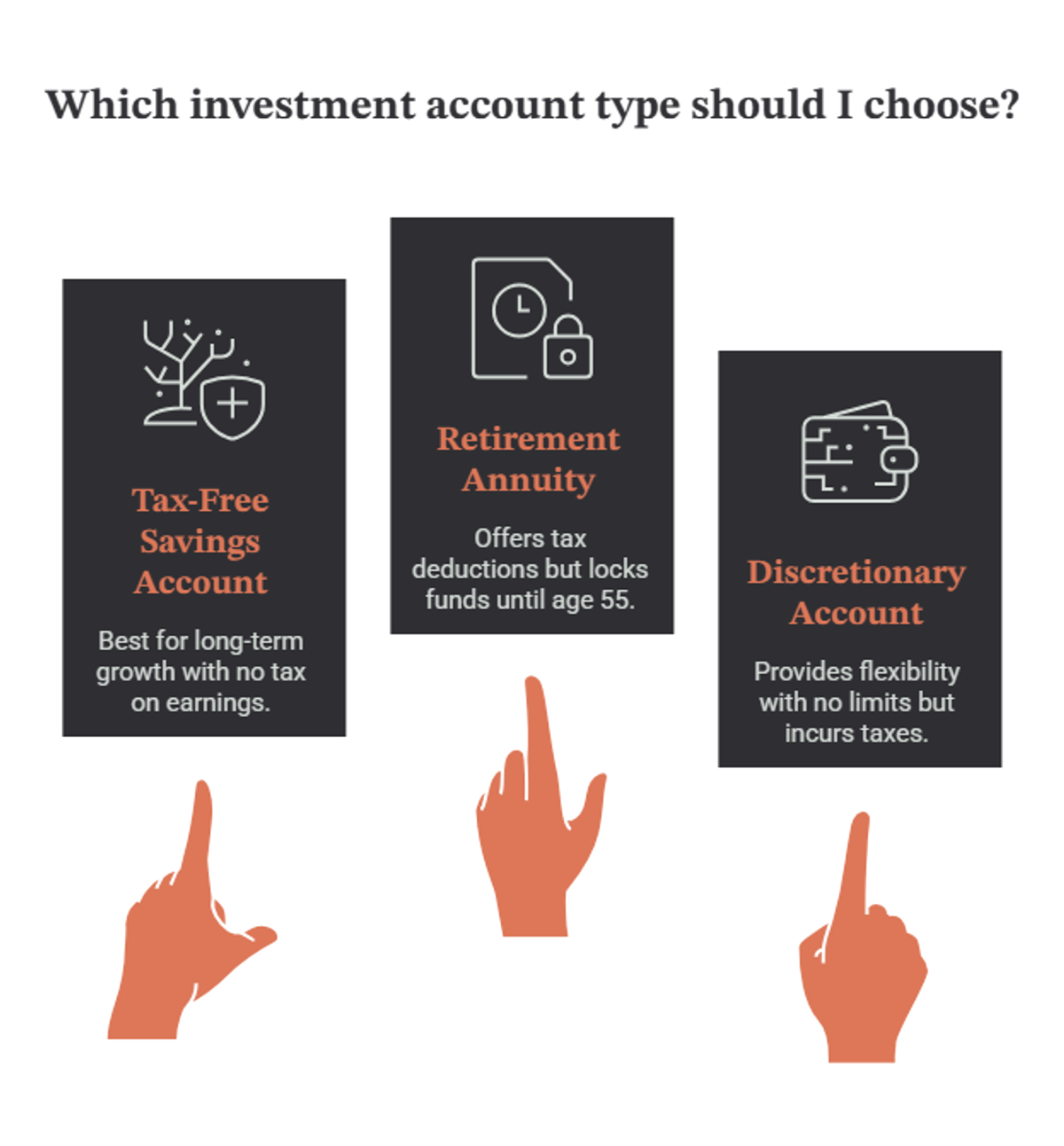
Tax-free savings account (TFSA). The best starting point for most people. You can contribute up to R46,000 per tax year (the year runs 1 March to the end of February), with a lifetime limit of R500,000. All growth, interest and dividends inside the account are completely free of tax, forever. Two rules to respect: contribute more than the limit and SARS charges a 40% penalty on the excess, and withdrawals don't free up room. If you take money out, you can't put it back without it counting as a fresh contribution. Treat it as long-term money.
Retirement annuity (RA). A retirement product with a tax twist: your contributions are deductible against your income, up to 27.5% of the greater of your taxable income or remuneration, capped at R350,000 a year. That deduction means SARS effectively refunds part of what you invest. The trade-off is that you can't access the money until age 55, and at retirement a portion must be used to provide an income. Good for disciplined long-term retirement saving, less flexible than a TFSA.
Ordinary (discretionary) investment account. A standard brokerage or unit trust account with no contribution limits and no access restrictions. You can withdraw any time. The downside is no tax shelter: you pay tax on dividends, interest above the annual exemption, and capital gains when you sell. Use this once you've made full use of your TFSA and RA, or when you need money that you might touch before retirement.
A sensible order for most people: fill the TFSA first, add an RA for the tax deduction, then use a discretionary account for anything beyond that.
Know what you're actually buying
The account is the wrapper. Inside it, you choose investments. The main building blocks:
Exchange-traded funds (ETFs). A single fund that holds a basket of shares or bonds tracking an index, like the JSE Top 40 or a global equity index. One purchase gives you instant diversification across dozens or hundreds of companies, and fees are low. For most beginners, a couple of broad, low-cost ETFs is all you need.
Unit trusts. Similar idea to ETFs but bought directly from a fund manager rather than on an exchange. Actively managed ones aim to beat the market and charge more for trying; many don't succeed after fees. Index-tracking unit trusts are a low-cost alternative.
Individual shares. Buying stock in single companies. Higher risk, because your money rides on one business rather than a spread of them. Fine in small doses once you know what you're doing, not where to start.
Bonds and cash. Lower risk, lower return. Useful for stability as you get closer to needing the money, less so when you're young with decades ahead.
For a beginner, the honest answer is usually: a low-cost, diversified ETF, held for the long term. It's boring, and that's the point.
Pick a platform
You buy investments through a platform. South African options aimed at beginners include EasyEquities, the major banks' investment arms, and dedicated providers like 10X, Sygnia and Satrix. When comparing them, look at:
- Fees. Platform fees, fund fees and trading costs all eat into returns over decades. Lower is better. A difference of even 1% a year compounds into a large sum over 20 years.
- TFSA support. Check the platform offers a tax-free account, not just a discretionary one.
- Minimums. Many let you start with a few hundred rand a month. Some fractional-share platforms let you start with even less.
- Ease of use. You'll engage with this more if the app isn't a chore.
Don't agonise over the perfect platform. Most reputable ones are fine. Starting matters more than optimising.
Decide your strategy and automate it
You don't need to time the market or pick winners. A simple, durable approach:
- Invest regularly, not in bursts. Set up a monthly debit order into your chosen investment. Buying steadily every month, regardless of whether the market is up or down, smooths out your average price and removes the temptation to guess. This is called rand-cost averaging.
- Diversify. Spread across many companies and, ideally, across countries. A global ETF plus a local one covers a lot of ground.
- Keep costs low. Fees are the one variable you control completely. Favour low-cost index funds.
- Leave it alone. The market falls sometimes. That's normal and not a reason to sell. The investors who do best are usually the ones who do least. Time in the market beats timing the market.
Automate the monthly contribution so it happens without you thinking about it, then review once or twice a year rather than checking daily.
Common mistakes to avoid
- Waiting until you have "enough" to start. R500 a month started now beats R5,000 a month started in five years, because of compounding. Begin small.
- Chasing last year's winner. The fund or share that soared recently often doesn't repeat it. Past performance isn't a promise.
- Panic-selling in a downturn. Selling after a fall locks in the loss. Staying invested lets the recovery work for you.
- Ignoring fees. A high-fee product can quietly cost you years of returns.
- Treating your TFSA as a piggy bank. Withdraw and you lose that contribution room for good.
A note on tax
Inside a TFSA, you owe nothing on growth. Outside one, three taxes can apply: dividends tax (withheld automatically), tax on interest above the annual exemption, and capital gains tax when you sell at a profit (there's an annual capital gains exclusion, R50,000 for the 2026/2027 year). This is exactly why filling your TFSA first is worth doing. If your affairs get complex, a fee-based financial adviser or tax practitioner is worth the cost.
Start now
The single most important step is the first one. Open a tax-free account with a low-cost platform, set up a small monthly debit order into a diversified ETF, and let time do the heavy lifting. You can refine as you learn. What you can't do is get back the years you spent waiting to feel ready.
Figures such as contribution limits and exclusions are set by National Treasury and updated most years in the February Budget. The amounts above apply to the 2026/2027 tax year. This is general information, not personal financial advice.
This is educational content, not financial advice. Consider your own situation, and speak to a registered adviser before making decisions.